Balance and Balance Training
From Understanding Neural Control to Improving Brain Health
Balance and balance training have been the common thread running through Prof. Taube’s research for more than two decades. His early publications on the spinal and cortical control of posture [1, 2] marked an important shift in the understanding of how postural control is organized and how it can be modified through training. At that time, animal research highlighting the importance of brainstem structures and spinal reflexes, together with studies of the fast spinal reflex pathways in humans, had led to the prevailing view that posture was controlled predominantly by subcortical structures and spinal mechanisms. However, the introduction of new neurophysiological approaches, particularly transcranial magnetic stimulation (TMS) and electroencephalography (EEG), made it possible to investigate cortical contributions to postural control more directly. These studies revealed that cortical structures, including the primary motor cortex, play an important role in both the regulation and adaptation of balance control [3, 4].
A further step towards understanding the neural network underlying balance control was achieved by investigating motor imagery (MI), action observation (AO), and their combination (AO+MI). Using functional magnetic resonance imaging (fMRI), we demonstrated that mentally performing or observing balance tasks activates an extensive network of cortical and subcortical brain areas involved in motor control [5]. Moreover, we showed that mental balance training can improve postural performance even in the absence of physical practice and without corresponding adaptations in spinal reflex pathways [6]. These findings provided compelling evidence that balance control is not merely a matter of spinal reflexes and subcortical regulation but relies on the coordinated involvement of a distributed cortical and subcortical motor network. More recently, using repetitive TMS to induce temporary, virtual lesions of the primary motor cortex, we demonstrated that this structure is essential for the consolidation of balance-related motor memories [7]. In addition, disrupting primary motor cortex function prevented the training-related upregulation of intracortical inhibition, highlighting the importance of this cortical area for experience-dependent neuroplasticity during balance learning [8].
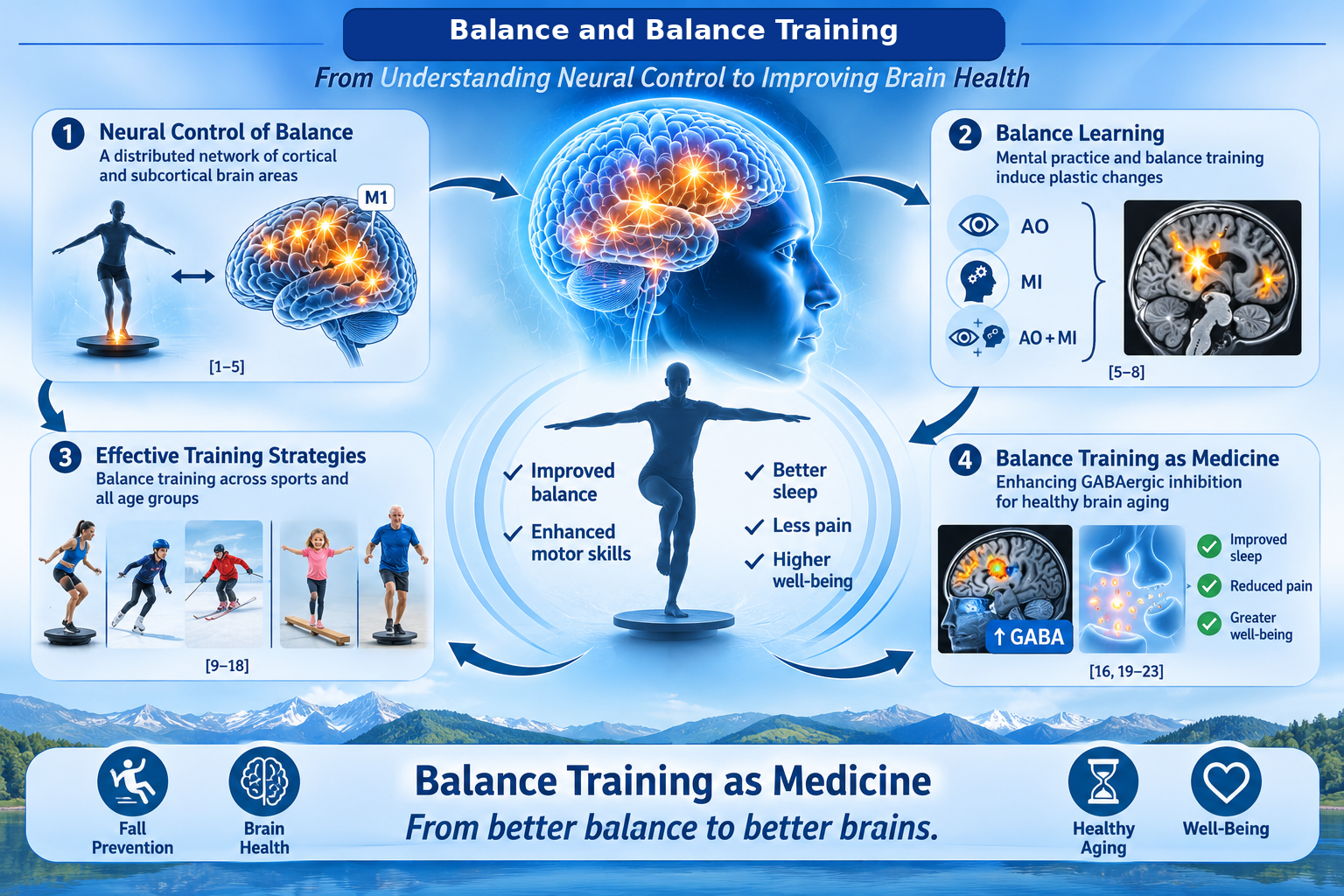
Another major focus of our research has been the identification of effective training strategies to improve postural control and the extent to which these improvements transfer to other motor skills. We demonstrated that conventional balance training not only improves postural stability but can also enhance explosive strength and jumping performance [9, 10]. Conversely, we showed that practicing other sport-specific skills, including inline skating, ice skating, and alpine skiing, can also improve balance control [11-13]. These findings highlight the bidirectional relationship between balance training and the development of broader motor performance capabilities.
Developing effective balance training programs for different age groups has proven more challenging. In young adults, balance training can induce remarkably rapid adaptations, with functional and structural changes in the brain detectable after only a few training sessions [14, 15]. However, when similar training approaches were applied to older adults, both behavioral and neurophysiological adaptations were surprisingly difficult to detect after five weeks of training [16]. Only after extending the training duration did we observe more pronounced adaptations, although transfer effects – for example, improvements in balance performance on an unfamiliar training device – remained limited [17, 18]. Interestingly, other research groups reported comparable challenges when training children, despite the high neuroplastic potential of the developing nervous system. In particular, improvements in balance performance were often small and showed limited transfer to untrained tasks. Motivation and concentration were suggested as potential factors limiting the effectiveness of conventional balance exercises in younger populations. In response, we developed age-appropriate balance training programs for children and adolescents that incorporated a strong emphasis on playful, varied, and motivating activities. These programs demonstrated that balance training can be successfully adapted to the specific needs of younger age groups [19].
More recently, our research has increasingly focused on using balance training as a form of “medicine” to promote brain health and healthy aging. While the beneficial effects of balance training on postural stability and fall prevention have been recognized for many years, we discovered that balance training can also enhance GABAergic inhibitory processes in the human brain [15, 20]. This finding is particularly relevant because the brain's inhibitory system is known to deteriorate with aging and is also implicated in a range of neurological and psychiatric conditions, including mild cognitive impairment, chronic pain, depression, ADHD, sleep disorders, and dystonia [21]. Thus, interventions capable of strengthening or restoring inhibitory function may have considerable potential beyond the improvement of motor performance.
We have demonstrated that balance training can counteract age-related reductions in intracortical inhibition, a functional indicator of GABAergic inhibitory activity, and increase the availability of GABA in the brain [17, 22, 23]. Importantly, these neurophysiological and neurochemical adaptations are not merely of theoretical interest: our findings indicate that they are accompanied by improvements in sleep quality, pain-related symptoms, and general well-being. In particular, our recent work demonstrated that enhancing GABAergic function in the sensorimotor cortex through balance training can improve subjective sleep quality in older adults [22]. Furthermore, a case study in a patient with chronic neuropathic pain provided initial evidence that balance-training-related changes in intracortical inhibition may also be associated with reductions in pain severity [24].
Taken together, these findings have opened up a promising new perspective on balance training: it may serve not only as an effective means of improving motor performance and preventing falls but also as a non-pharmacological strategy to promote brain health, support healthy aging, and counteract age-related or disease-related impairments in inhibitory brain function. For further information about our research, please visit the website of our research group [link].
Let’s end with this take home message: From better balance to better brains. Balance training is more than fall prevention. It represents a promising non-pharmacological approach to enhancing inhibitory brain function, supporting sleep and well-being, and promoting healthy brain aging.
1. Taube, W., M. Schubert, M. Gruber, S. Beck, M. Faist, and A. Gollhofer, Direct corticospinal pathways contribute to neuromuscular control of perturbed stance. Journal of Applied Physiology, 2006. 101(2): p. 420-429.
2. Taube, W., M. Gruber, S. Beck, M. Faist, A. Gollhofer, and M. Schubert, Cortical and spinal adaptations induced by balance training: correlation between stance stability and corticospinal activation. Acta Physiologica, 2007. 189(4): p. 347-358.
3. Taube, W., M. Gruber, and A. Gollhofer, Spinal and supraspinal adaptations associated with balance training and their functional relevance. Acta Physiologica, 2008. 193(2): p. 101-116.
4. Tokuno, C.D., W. Taube, and A.G. Cresswell, An enhanced level of motor cortical excitability during the control of human standing. Acta Physiol (Oxf), 2009. 195(3): p. 385-95.
5. Taube, W., M. Mouthon, C. Leukel, H.M. Hoogewoud, J.M. Annoni, and M. Keller, Brain activity during observation and motor imagery of different balance tasks: an fMRI study. Cortex, 2015. 64(0): p. 102-14.
6. Taube, W., M. Lorch, S. Zeiter, and M. Keller, Non-physical practice improves task performance in an unstable, perturbed environment: motor imagery and observational balance training. Front Hum Neurosci, 2014. 8: p. 972.
7. Egger, S., M. Wälchli, E. Rüeger, and W. Taube, Short-term balance consolidation relies on the primary motor cortex: a rTMS study. Sci Rep, 2023. 13(1): p. 5169.
8. Egger, S., M. Wälchli, S. Meyer, and W. Taube, Repetitive Magnetic Stimuli Over the Motor Cortex Impair Consolidation of a Balance Task by Suppressing Up-Regulation of Intracortical Inhibition. Eur J Neurosci, 2025. 61(11): p. e70161.
9. Gruber, M., S.B. Gruber, W. Taube, M. Schubert, S.C. Beck, and A. Gollhofer, Differential effects of ballistic versus sensorimotor training on rate of force development and neural activation in humans. J Strength Cond Res, 2007. 21(1): p. 274-82.
10. Taube, W., N. Kullmann, C. Leukel, O. Kurz, F. Amtage, and A. Gollhofer, Differential reflex adaptations following sensorimotor and strength training in young elite athletes. Int J Sports Med, 2007. 28(12): p. 999-1005.
11. Taube, W., D. Bracht, C. Besemer, and A. Gollhofer, The Effect of Inline Skating on Postural Control in Elderly People. Deutsche Zeitschrift Fur Sportmedizin, 2010. 61(2): p. 45-51.
12. Keller, M., K. Rottger, and W. Taube, Ice skating promotes postural control in children. Scand J Med Sci Sports, 2014. 24(6): p. e456-461.
13. Lauber, B., M. Keller, A. Gollhofer, E. Muller, and W. Taube, Spinal reflex plasticity in response to alpine skiing in the elderly. Scand J Med Sci Sports, 2011. 21 Suppl 1: p. 62-8.
14. Taubert, M., B. Draganski, A. Anwander, K. Muller, A. Horstmann, A. Villringer, and P. Ragert, Dynamic properties of human brain structure: learning-related changes in cortical areas and associated fiber connections. J Neurosci, 2010. 30(35): p. 11670-7.
15. Mouthon, A. and W. Taube, Intracortical Inhibition Increases during Postural Task Execution in Response to Balance Training. Neuroscience, 2019. 401: p. 35-42.
16. Ruffieux, J., A. Mouthon, M. Keller, M. Walchli, and W. Taube, Behavioral and neural adaptations in response to five weeks of balance training in older adults: a randomized controlled trial. J Negat Results Biomed, 2017. 16(1): p. 11.
17. Kuhn, Y.A., S. Egger, M. Bugnon, N. Lehmann, M. Taubert, and W. Taube, Age-related decline in GABAergic intracortical inhibition can be counteracted by long-term learning of balance skills. J Physiol, 2024. 602(15): p. 3737-3753.
18. Lehmann, N., Y.A. Kuhn, M. Keller, N. Aye, F. Herold, B. Draganski, W. Taube, and M. Taubert, Brain Activation During Active Balancing and Its Behavioral Relevance in Younger and Older Adults: A Functional Near-Infrared Spectroscopy (fNIRS) Study. Frontiers in Aging Neuroscience, 2022. 14.
19. Wälchli, M., J. Ruffieux, A. Mouthon, M. Keller, and W. Taube, Is Young Age a Limiting Factor When Training Balance? Effects of Child-Oriented Balance Training in Children and Adolescents. Pediatr Exerc Sci, 2018. 30(1): p. 176-184.
20. Taube, W., A. Gollhofer, and B. Lauber, Training-, muscle- and task-specific up- and downregulation of cortical inhibitory processes. Eur J Neurosci, 2020. 51(6): p. 1428-1440.
21. Taube, W. and B. Lauber, Changes in the cortical GABAergic inhibitory system with ageing and ageing-related neurodegenerative diseases. Journal of Physiology-London, 2026. 604(2): p. 689-706.
22. Scherrer, S., S. Egger, X. Liu, A.Z. Wick, B. Rasch, L. Xin, B. Lauber, and W. Taube, Improved subjective sleep quality in older adults by enhancing the GABAergic system in the sensorimotor cortex. J Physiol, 2026. 604(15): p. 6506-6546.
23. Liu, X., S. Scherrer, S. Egger, S.I. Lim, B. Lauber, I. Jelescu, A. Griffa, G. Gambarota, W. Taube, and L. Xin, Rebalance the Inhibitory System in the Elderly Brain: Influence of Balance Learning on GABAergic Inhibition and Functional Connectivity. Hum Brain Mapp, 2024. 45(16): p. e70057.
24. Taube, W., N. Mory, F. Peier, M. Mouthon, J.N. Chabwine, and B. Lauber, Balance Training-Related Changes in Intracortical Inhibition and Symptom Severity in a Patient with Chronic Neuropathic Pain: A Single-Case Study. Brain Sciences, 2026. 16(2).