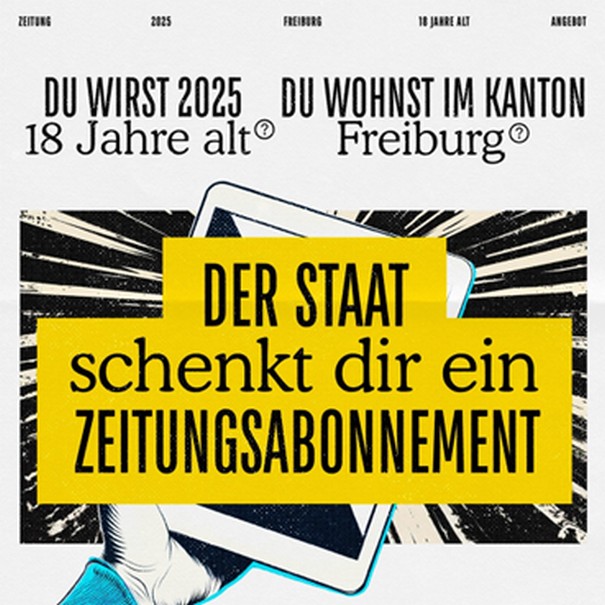
Evaluation of the Media Promotion Initiative "Free Subscriptions for Young People" in the Cantons of Fribourg and Geneva
- Project team: Sina Blassnig (IDCMI, Unifr/FHGR), Manuel Puppis (DCM, Unifr), Seraina Tarnutzer (IDCMI, Unifr/FHGR), and Stefano Pedrazzi (DCM, Unifr)
- Duration: 01.12.2024 – 30.06.2026
- Funding: Federal Office of Communications (OFCOM)
The research project ‘Evaluation of the media promotion initiative “Free Subscriptions for Young People” in the cantons of Fribourg and Geneva (2024–2026)’ examines the links between young adults’ media usage, their media literacy, their interest in politics, and a newly introduced free newspaper subscription scheme for young adults in the cantons of Fribourg and Geneva. The aim is to determine whether this measure could strengthen young people’s interest in local and regional news, as well as their media literacy and political participation.
The project employs a mixed-methods design that combines quantitative and qualitative approaches. It comprises a standardised online survey of young adults in the cantons of Fribourg, Geneva, Basel-Stadt and Neuchâtel, conducted in two waves: the first in May 2025 and the second in May 2026. The cantons of Basel-Stadt and Neuchâtel, which currently have no comparable media promotion measures in place, serve as a basis for comparison. In addition, several cohorts of young people will be surveyed to enable a comparison between age groups that have already benefited from the measure and those that have not. To complement this, focus groups will be conducted with young adults who have taken up the free subscription, as well as expert interviews with media professionals in Fribourg and Geneva.
At a time when the media industry is under severe economic pressure and the use of traditional news media is in decline, this project offers valuable insights into the effectiveness of media promotion initiatives. The findings could reveal whether and how such measures can help to better inform and politically mobilise young adults. This is particularly important for fostering an informed and active citizenry and could serve as a model for similar initiatives in other regions. The findings from this study could therefore be of great significance both for media policy and for the day-to-day operations of media organisations.